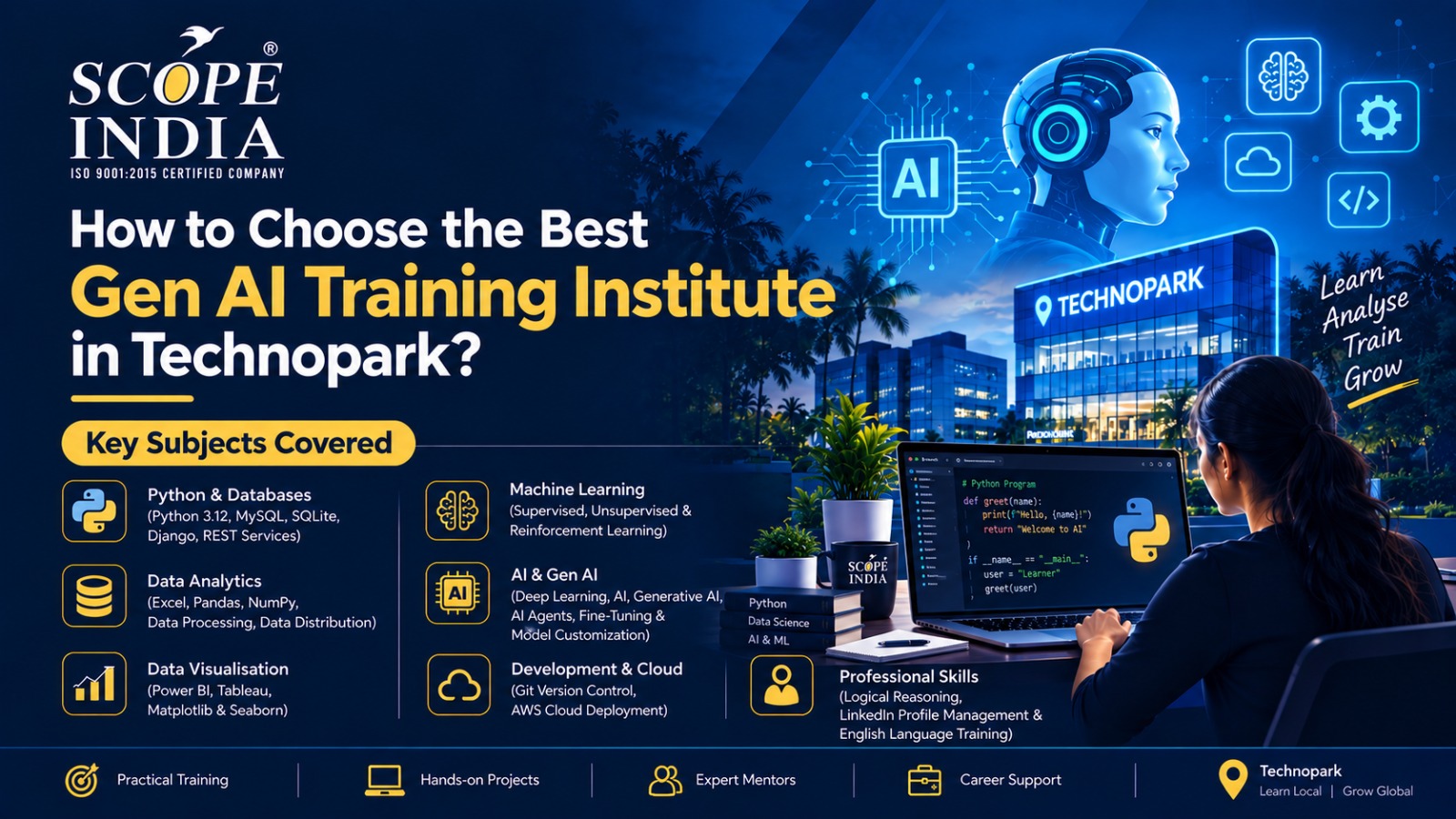





Gen AI Training in Technopark: Essential Skills for Aspiring AI Professionals
Artificial Intelligence is transforming the way businesses operate, develop products, analyse information, and interact with customers. Among the latest developments, Generative AI has created new possibilities in content creation, automation, software development, data analysis, and intelligent applications.
For students and aspiring technology professionals, learning AI requires more than understanding a few AI tools. A strong foundation in programming, data, machine learning, application development, and modern AI technologies can help learners develop practical skills.
Gen AI Training in Technopark can be a suitable learning path for those who want to understand these technologies in a structured way and prepare themselves for opportunities in the technology sector.
Why Learn Gen AI in Technopark?
Technopark is a major technology hub in Kerala, making it a relevant environment for people interested in building careers in IT and emerging technologies.
Some reasons learners may consider training in this area include:
- Technology-focused professional environment
- Exposure to modern IT practices
- Opportunities to develop practical technical skills
- Focus on software and digital technologies
- Access to a growing technology ecosystem
- Scope to build industry-oriented projects
- Opportunities to improve professional and communication skills
However, the location alone should not be the deciding factor. The quality of the curriculum, practical training, projects, and career support are equally important.
Essential Skills for Aspiring AI Professionals
An aspiring AI professional needs a combination of technical knowledge and professional skills. A good learning program can gradually introduce learners to programming, data, AI, application development, cloud technologies, and career preparation.
Subjects Covered
- Python 3.12
- MySQL
- SQLite
- Django
- REST Services
- Regular Expressions
- Microsoft Excel
- Power BI
- Data Processing Using Pandas
- NumPy
- Matplotlib and Seaborn
- Data Visualisation Using Tableau
- Data Distribution
- Machine Learning
- Deep Learning & Artificial Intelligence
- Generative AI
- AI Agents
- Fine-Tuning & Model Customization
- GIT Version Control
- AWS Cloud Application Deployment
- Logical Reasoning
- LinkedIn Profile Management
- English Language Training
1. Develop Strong Programming Fundamentals
Programming is an important starting point for anyone planning to work in AI. Python is particularly useful because it is widely used across data processing, machine learning, automation, and AI application development.
Aspiring professionals should focus on:
- Understanding programming logic
- Writing clean and readable code
- Working with data
- Solving programming problems
- Understanding functions and modules
- Developing small applications
- Practising regularly
A strong programming foundation can make advanced AI concepts easier to understand.
2. Build Data Handling Skills
AI systems depend heavily on data. Therefore, understanding how to work with data is an important skill for aspiring AI professionals.
Learners should develop the ability to:
- Collect and organise data
- Clean datasets
- Process information
- Analyse patterns
- Understand data distribution
- Create visualisations
- Present findings clearly
These skills can also be useful in data analysis and other technology-related career paths.
3. Understand Machine Learning Concepts
Machine learning is an important foundation for understanding modern AI systems. Instead of simply using AI tools, learners can benefit from understanding how machine learning approaches work.
Important areas to explore include:
- Basic machine learning concepts
- Training and testing data
- Model development
- Pattern recognition
- Prediction
- Model evaluation
- Practical machine learning applications
Learning through projects can make these concepts easier to connect with real-world problems.
4. Progress Towards Deep Learning and AI
After developing a foundation in programming, data, and machine learning, learners can move towards deeper AI concepts.
This stage can introduce:
- Neural networks
- Deep learning concepts
- AI applications
- Model training
- Intelligent systems
- Practical AI solutions
The objective should be to understand how different AI technologies connect with one another.
5. Learn Generative AI
Generative AI has expanded the possibilities of Artificial Intelligence by enabling systems to generate text, images, code, and other types of content.
Aspiring professionals can explore:
- Generative AI fundamentals
- Large Language Models
- Prompt Engineering
- AI-powered applications
- AI automation
- Content generation
- Intelligent assistants
- AI-based workflows
The important point is not just learning how to use an AI tool, but understanding how Generative AI can be integrated into practical applications.
6. Understand AI Agents
AI Agents are becoming an important area of modern AI development. They can be designed to perform tasks, interact with tools, process information, and follow workflows.
Learners can explore:
- How AI Agents work
- Agent-based workflows
- Tool integration
- Task automation
- Decision-making workflows
- AI-powered assistants
- Practical agent applications
Understanding these concepts can help learners explore newer developments in Generative AI.
7. Explore Fine-Tuning and Model Customization
Different applications may require AI models to work with specific information, formats, or use cases. This makes model customization an important area to explore.
Learners can gain an understanding of:
- Model customization concepts
- Fine-tuning fundamentals
- Preparing suitable data
- Adapting models for specific requirements
- Evaluating customized results
- Responsible use of AI models
This provides a pathway from simply using AI models to understanding how they can be adapted for different applications.
8. Learn Application Development
AI skills become more practical when learners understand how AI features can be integrated into software applications.
Application development skills can help with:
- Creating web applications
- Connecting applications with databases
- Building APIs
- Integrating AI features
- Developing user-focused solutions
- Testing applications
This combination can help learners understand the complete process of turning an AI concept into a usable application.
9. Develop Data Visualisation Skills
Being able to communicate data effectively is another valuable skill. Visualisation can make complex information easier to understand.
Learners should practise:
- Creating charts
- Presenting datasets
- Identifying patterns
- Building dashboards
- Communicating insights
- Preparing visual reports
These skills can support both technical and business-oriented roles.
10. Learn Git and Cloud Deployment
Modern software projects often involve collaboration and cloud-based development. Understanding version control and deployment can therefore complement AI skills.
Important areas include:
- Managing code versions
- Working with repositories
- Collaborating on projects
- Maintaining project history
- Deploying applications
- Understanding cloud environments
Cloud deployment experience can also help learners understand what happens after an application has been developed.
11. Focus on Practical Projects
One of the most useful ways to develop AI skills is through hands-on projects.
A project can bring several learning areas together:
Python → Data Processing → Machine Learning → Generative AI → Application Development → API Integration → Cloud Deployment
Project-based learning can help students:
- Apply theoretical knowledge
- Solve practical problems
- Understand development workflows
- Build a professional portfolio
- Demonstrate technical abilities
- Gain confidence in presenting their work
A portfolio containing meaningful projects can provide evidence of practical learning when applying for opportunities.
12. Develop Professional Skills
Technical skills are important, but aspiring professionals also need to communicate their knowledge effectively.
Career preparation can include:
- Logical reasoning
- Communication skills
- English language development
- Resume preparation
- LinkedIn profile management
- Interview preparation
- Portfolio development
- Professional presentation
These skills can help learners present themselves more confidently during job searches and interviews.
13. Follow a Structured Learning Path
AI can appear complicated because it includes many different technologies. A structured learning path can make the process more manageable.
A beginner-friendly progression can be:
- Learn programming fundamentals
- Understand databases and data
- Develop data processing skills
- Learn machine learning
- Explore deep learning and AI
- Move into Generative AI
- Understand AI Agents
- Explore model customization
- Build AI-powered applications
- Learn version control and cloud deployment
- Complete practical projects
- Prepare for professional opportunities
Following a gradual progression can help learners build knowledge without trying to understand every advanced concept at once.
How to Choose Gen AI Training in Technopark
Before joining a training program, students can compare institutes based on several factors.
Curriculum
Check whether the course covers both fundamental and advanced AI concepts.
Practical Learning
Look for hands-on assignments and projects rather than theory-only classes.
Updated Technologies
AI changes quickly, so the curriculum should include relevant modern technologies and applications.
Project Experience
Check whether learners get opportunities to create projects that can be added to their portfolio.
Development Skills
AI training can be more comprehensive when it also includes application development, APIs, databases, version control, and deployment.
Career Support
Consider whether the institute provides support related to:
- Resume preparation
- Interview preparation
- Communication
- LinkedIn profile development
- Portfolio building
- Career guidance
Career Areas After Gen AI Training
After developing relevant skills, learners can explore different areas depending on their education, experience, and interests.
Potential areas include:
- Artificial Intelligence
- Generative AI
- Machine Learning
- Data Analysis
- Data Science
- Python Development
- AI Application Development
- Automation
- Software Development
- AI-powered business solutions
- Cloud-based application development
Career requirements can differ between organisations, so continuous learning and practical experience remain important.
Keep Learning After Training
Completing a course is only the beginning of an AI learning journey. New models, tools, frameworks, and applications continue to emerge.
Aspiring professionals can maintain their skills by:
- Building new projects
- Following AI developments
- Practising programming
- Exploring new AI tools
- Reading technical resources
- Improving existing projects
- Updating their portfolio
- Participating in practical learning activities
Consistent practice can help learners stay familiar with changing technologies.
Conclusion
Gen AI Training in Technopark: Essential Skills for Aspiring AI Professionals is not only about learning Generative AI tools. A strong AI learning journey can include programming, data processing, machine learning, Artificial Intelligence, Generative AI, application development, cloud deployment, and professional skills.
For aspiring AI professionals, the goal should be to build a balanced combination of technical knowledge, practical experience, problem-solving ability, and communication skills. Choosing a structured training program and consistently working on practical projects can help learners prepare for the evolving technology industry.